The International Monetary System Can Be Defined as the Institutional Framework Within Which
An international monetary system is a set of internationally agreed rules, conventions and supporting institutions that facilitate international trade, cantankerous border investment and by and large the reallocation of uppercase between states that have dissimilar currencies.[1] It should provide means of payment acceptable to buyers and sellers of different nationalities, including deferred payment. To operate successfully, it needs to inspire confidence, to provide sufficient liquidity for fluctuating levels of merchandise, and to provide ways by which global imbalances can be corrected. The organization tin grow organically every bit the collective result of numerous individual agreements between international economic factors spread over several decades. Alternatively, it can arise from a single architectural vision, every bit happened at Bretton Forest in 1944.
Historical overview [edit]
Throughout history, precious metals such as gold and argent have been used for trade, sometimes in the form of bullion, and from early history the coins of diverse issuers – generally kingdoms and empires – have been traded. The earliest known records of pre-coinage use of precious metals for monetary exchange are from Mesopotamia and Egypt, dating from the third millennium BC.[2] Early money took many forms, autonomously from bullion; for case bronze spade money which became common in Zhou dynasty Mainland china in the late 7th century BC. At that fourth dimension, forms of money were likewise developed in Lydia in Asia Minor, from where its use spread to nearby Greek cities and afterwards to many other places.[2]
Sometimes formal budgetary systems have been imposed by regional rulers. For example, scholars have tentatively suggested that the Roman king Servius Tullius created a primitive monetary system in the early history of Rome. Tullius reigned in the 6th century BC - several centuries before Rome is believed to have developed a formal coinage system.[3]
As with bullion, early on apply of coinage is believed to have been mostly the preserve of the aristocracy. But by about the 4th century BC coins were widely used in Greek cities. They were mostly supported by the city state authorities, who endeavoured to ensure they retained their values regardless of fluctuations in the availability of whatever base or precious metals they were fabricated from.[2] From Greece the use of coins spread slowly westwards throughout Europe, and eastwards to India. Coins were in apply in Republic of india from about 400 BC; initially they played a greater role in religion than in trade, but by the 2nd century[ description needed ] they had become fundamental to commercial transactions. Budgetary systems that were adult in India were so successful that they spread through parts of Asia well into the Middle Ages.[ii]
As a variety of coins became common inside a region, they were exchanged by moneychangers, the predecessors of today's foreign exchange market place, as mentioned in the Biblical story of Jesus and the money changers. In Venice and the other Italian metropolis states of the early on Middle Ages, money changers would often take to struggle to perform calculations involving six or more currencies. This partly led to Fibonacci writing his Liber Abaci which popularised the use of Indo-Arabic numerals, which displaced the more hard Roman numerals then in use past western merchants.[four]

When a given nation or empire has achieved regional hegemony, its currency has been a basis for international trade, and hence for a de facto budgetary organization. In the West – Europe and the Heart Due east – an early such coin was the Persian daric. This was succeeded by Roman currency of the Roman Empire, such as the denarius, and so the Gilt Dinar of the Ottoman Empire, and afterward – from the 16th to 20th centuries, during the Age of Imperialism – by the currency of European colonial powers: the Spanish dollar, the Dutch guilder, the French franc and the British pound sterling; at times i currency has been pre-eminent, at times no i dominated. With the growth of American power, the US dollar became the basis for the international monetary organization, formalised in the Bretton Wood agreement that established the postal service–World War Two budgetary guild, with stock-still exchange rates of other currencies to the dollar, and convertibility of the dollar into gold. The Bretton Wood system broke downward, culminating in the Nixon shock of 1971, catastrophe convertibility; but the US dollar has remained the de facto basis of the world monetary system, though no longer de jure [ dubious ], with diverse European currencies and the Japanese yen also existence prominent in foreign exchange markets. Since the formation of the Euro, the Euro has also gained utilise as a reserve currency and a medium of transactions, though the dollar has remained the most important currency.
A dominant currency may be used directly or indirectly by other nations: for example, English kings minted the gold mancus, presumably to role as dinars to commutation with Islamic Spain; colonial powers sometimes minted coins that resembled those already used in a afar territory; and more than recently, a number of nations accept used the U.s. dollar as their local currency, a custom called dollarization.
Until the 19th century, the global budgetary system was loosely linked at all-time, with Europe, the Americas, India and China (among others) having largely separate economies, and hence monetary systems were regional. European colonization of the Americas, starting with the Spanish empire, led to the integration of American and European economies and monetary systems, and European colonization of Asia led to the dominance of European currencies, notably the British pound sterling in the 19th century, succeeded by the US dollar in the 20th century. Some, such as Michael Hudson, foresee the decline of a single base for the global monetary system, and the emergence instead of regional trade blocs; he cites the emergence of the Euro as an example. Encounter also Global financial systems, world-systems approach and polarity in international relations. It was in the later half of the 19th century that a monetary organisation with close to universal global participation emerged, based on the gilt standard.
History of mod global monetary orders [edit]
Co-ordinate to J. Lawrence Broz and Jeffry A. Frieden, the sustainability of international budgetary cooperation has tended to exist affected by:[5]
- A shared involvement in currency stability
- Interlinkages to other important problems
- The presence of institutions that formalize the international monetary cooperation
- The number of actors involved, in particular whether one or a few powerful states are willing to take the lead in managing international monetary diplomacy
- Macroeconomic conditions (during economic downturns, states are incentivized to defect from international monetary cooperation)
The pre WWI financial gild: 1816–1919 [edit]
From the 1816 to the outbreak of Earth War I in 1914, the world benefited from a well-integrated financial order, sometimes known as the "beginning age of globalisation".[6] [7] There were monetary unions which enabled member countries to have each other's currencies as legal tender. Such unions included the Latin Monetary Matrimony (Belgium, Italy, Switzerland, France) and the Scandinavian monetary union (Denmark, Norway and Sweden). In the absence of shared membership of a matrimony, transactions were facilitated by widespread participation in the gold standard, by both independent nations and their colonies. Britain was at the fourth dimension the earth's pre-eminent fiscal, royal, and industrial power, ruling more than of the world and exporting more than majuscule as a percentage of her national income than whatever other creditor nation has since.[viii]
While capital controls comparable to the Bretton Woods organisation were not in place, dissentious capital flows were far less common than they were to be in the post 1971 era. In fact United kingdom of great britain and northern ireland's upper-case letter exports helped to correct global imbalances as they tended to be counter-cyclical, ascent when Great britain'southward economy went into recession, thus compensating other states for income lost from export of appurtenances.[9] Appropriately, this era saw more often than not steady growth and a relatively low level of fiscal crises. In contrast to the Bretton Woods system, the pre–Globe War I financial social club was non created at a single loftier level conference; rather it evolved organically in a serial of discrete steps. The Golden Age, a fourth dimension of peculiarly rapid development in Due north America, falls into this menstruation.
Between the World Wars: 1919–1939 [edit]

The years between the world wars take been described equally a menstruation of "de-globalisation", as both international trade and capital flows shrank compared to the menstruation before World State of war I. During World State of war I, countries had abandoned the gold standard. Except for the United States, they later returned to it only briefly. By the early 1930s, the prevailing order was essentially a fragmented arrangement of floating exchange rates.[10] In this era, the experience of U.k. and others was that the gilded standard ran counter to the need to retain domestic policy autonomy. To protect their reserves of golden, countries would sometimes need to raise interest rates and by and large follow a deflationary policy. The greatest demand for this could ascend in a downturn, just when leaders would have preferred to lower rates to encourage growth. Economist Nicholas Davenport [11] had even argued that the wish to return Britain to the gilded standard "sprang from a sadistic desire by the Bankers to inflict pain on the British working grade".
By the terminate of Globe State of war I, Great United kingdom of great britain and northern ireland was heavily indebted to the Usa, allowing the US to largely displace it as the globe's foremost financial power. The United States, however, was reluctant to presume U.k.'due south leadership role, partly due to isolationist influences and a focus on domestic concerns. In contrast to Great Britain in the previous era, upper-case letter exports from the US were not countercyclical. They expanded rapidly with the United states of america' economic growth in the 1920s until 1928, but then nigh completely halted every bit the US economy began slowing in that year. As the Great Low intensified in 1930, financial institutions were striking hard along with trade; in 1930 alone, 1345 The states banks collapsed. [12] During the 1930s, the United states of america raised trade barriers, refused to act as an international lender of last resort, and refused calls to abolish war debts, all of which further aggravated economic hardship for other countries. According to economist John Maynard Keynes, another factor contributing to the turbulent economical performance of this era was the insistence of French premier Clemenceau that Deutschland pay war reparations at also loftier a level, which Keynes described in his volume The Economic Consequences of the Peace.
The Bretton Woods Era: 1944–1973 [edit]
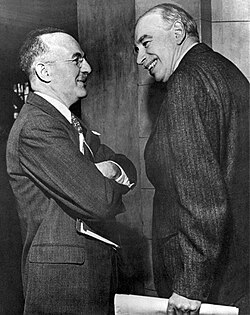
British and American policy makers began to plan the mail-war international monetary system in the early 1940s. The objective was to create an lodge that combined the benefits of an integrated and relatively liberal international system with the freedom for governments to pursue domestic policies aimed at promoting full employment and social wellbeing.[thirteen] The primary architects of the new system, John Maynard Keynes and Harry Dexter White, created a plan which was endorsed by the 42 countries attention the 1944 Bretton Woods conference, formally known as the United Nations Monetary and Financial Conference. The programme involved nations agreeing to a system of fixed but adjustable[ clarification needed ] exchange rates and so that the currencies were pegged against the dollar, with the dollar itself convertible into aureate. So in consequence this was a gold – dollar exchange standard. There were a number of improvements on the onetime gold standard. Two international institutions, the International monetary fund (IMF) and the Globe Bank were created. A key part of their function was to replace individual finance as a more reliable source of lending for investment projects in developing states. At the fourth dimension the soon to be defeated powers of Germany and Japan were envisaged as states soon to be in need of such development, and in that location was a want from both the Us and Britain not to see the defeated powers saddled with punitive sanctions that would inflict lasting hurting on future generations. The new exchange rate system immune countries facing economic hardship to devalue their currencies past upwards to 10% against the dollar (more if approved past the Imf) – thus they would non be forced to undergo deflation to stay in the gold standard. A system of capital controls was introduced to protect countries from the dissentious effects of uppercase flight and to permit countries to pursue independent macro economical policies [fourteen] while still welcoming flows intended for productive investment. Keynes had argued confronting the dollar having such a cardinal role in the monetary arrangement, and suggested an international currency chosen bancor be used instead, but he was overruled by the Americans. Towards the end of the Bretton Woods era, the central role of the dollar became a problem as international demand somewhen forced the US to run a persistent trade deficit, which undermined conviction in the dollar. This, together with the emergence of a parallel marketplace for gold in which the price soared above the official US mandated cost, led to speculators running down the United states gold reserves. Even when convertibility was restricted to nations only, some, notably France,[fifteen] continued building up hoards of gold at the expense of the US. Eventually these pressures caused President Nixon to end all convertibility into gilt on 15 August 1971. This event marked the effective end of the Bretton Woods system; attempts were made to find other mechanisms to preserve the fixed substitution rates over the adjacent few years, only they were not successful, resulting in a system of floating exchange rates.[15]
The post Bretton Woods arrangement: 1973– present [edit]
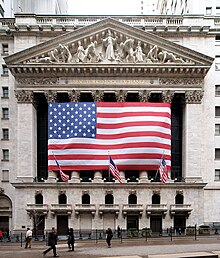
An alternative name for the post Bretton Woods system is the Washington Consensus. While the name was coined in 1989, the associated economic system came into effect years earlier: according to economic historian Lord Skidelsky the Washington Consensus is generally seen as spanning 1980–2009 (the latter half of the 1970s being a transitional period).[sixteen] The transition away from Bretton Wood was marked past a switch from a state led to a market place led system.[6] The Bretton Wood arrangement is considered by economical historians to have broken down in the 1970s:[xvi] crucial events being Nixon suspending the dollar's convertibility into gold in 1971, the U.s.' abandonment of capital controls in 1974, and the UK'southward ending of uppercase controls in 1979 which was swiftly copied past well-nigh other major economies.
In some parts of the developing world, liberalisation brought meaning benefits for large sections of the population – most prominently with Deng Xiaoping'southward reforms in Mainland china since 1978 and the liberalisation of Republic of india after its 1991 crisis.
Generally the industrial nations experienced much slower growth and higher unemployment than in the previous era, and according to Professor Gordon Fletcher in hindsight the 1950s and 60s when the Bretton Woods organisation was operating came to exist seen every bit a gilded age. [17] Financial crises take been more intense and have increased in frequency by about 300% – with the damaging furnishings prior to 2008 beingness chiefly felt in the emerging economies. On the positive side, at least until 2008 investors have oftentimes achieved very high rates of return, with salaries and bonuses in the fiscal sector reaching tape levels.
Calls for a "New Bretton Wood" [edit]

Leading financial journalist Martin Wolf has reported that all financial crises since 1971 have been preceded by big capital inflows into affected regions. While ever since the seventies there have been numerous calls from the global justice motility for a revamped international system to tackle the problem of unfettered uppercase flows, it was not until late 2008 that this idea began to receive substantial support from leading politicians. On September 26, 2008, French President Nicolas Sarkozy, then also the President of the European Spousal relationship, said, "We must rethink the financial system from scratch, every bit at Bretton Woods."[xviii]
On October 13, 2008, British Prime number Government minister Gordon Chocolate-brown said world leaders must meet to agree to a new economic system:
We must have a new Bretton Woods, building a new international financial architecture for the years ahead.[19]
However, Brown's approach was quite different from the original Bretton Woods system, emphasising the continuation of globalization and gratuitous trade as opposed to a return to fixed exchange rates.[twenty]
There were tensions between Dark-brown and Sarkozy, the latter of whom argued that the "Anglo-Saxon" model of unrestrained markets had failed.[21] However European leaders were united in calling for a "Bretton Forest II" summit to redesign the globe's fiscal architecture.[22] President Bush-league was amusing to the calls, and the resulting meeting was the 2008 G-xx Washington summit. International understanding was achieved for the mutual adoption of Keynesian financial stimulus,[23] an area where the U.s.a. and Red china were to emerge as the earth'southward leading actors.[24] Even so in that location was no substantial progress towards reforming the international fiscal system, and nor was there at the 2009 coming together of the World Economic Forum at Davos [25]
Despite this lack of results leaders continued to campaign for Bretton Wood II. Italian Economics Government minister Giulio Tremonti said that Italia would use its 2009 G7 chairmanship to push for a "New Bretton Wood". He had been critical of the U.Due south.'s response to the global financial crunch of 2008, and had suggested that the dollar may be superseded equally the base currency of the Bretton Wood organization.[26] [27] [28]
Choike, a portal organisation representing Southern Hemisphere NGOs, called for the institution of "international permanent and binding mechanisms of control over upper-case letter flows" and every bit of March 2009 had accomplished over 550 signatories from civil society organisations. [29]
| System | Reserve assets | Leaders |
|---|---|---|
| Flexible substitution rates[30] | Dollar, euro, renminbi | United states of america, Eurozone, China |
| Special drawing rights standard[31] | SDR | U.s., M-twenty, IMF |
| Gilded standard[32] | Gold, dollar | US |
| Delhi Declaration[33] [34] | Currency basket | BRICS |
March 2009 saw Gordon Brown continuing to abet for reform and the granting of extended powers to international financial institutions like the International monetary fund at the April G20 summit in London, [35] and was said to take president Obama's back up .[36] Also during March 2009, in a speech communication entitled Reform the International Budgetary Arrangement, Zhou Xiaochuan, the governor of the People'due south Bank of Cathay came out in favour of Keynes's idea of a centrally managed global reserve currency. Dr Zhou argued that it was unfortunate that part of the reason for the Bretton Forest system breaking down was the failure to adopt Keynes'due south bancor. Dr Zhou said that national currencies were unsuitable for utilise equally global reserve currencies as a result of the Triffin dilemma – the difficulty faced past reserve currency issuers in trying to simultaneously achieve their domestic monetary policy goals and run across other countries' demand for reserve currency. Dr Zhou proposed a gradual move towards increased use of International monetary fund special cartoon rights (SDRs) every bit a centrally managed global reserve currency [37] [38] His proposal attracted much international attention.[39] In a Nov 2009 article published in Foreign Diplomacy mag, economist C. Fred Bergsten argued that Dr Zhou'south suggestion or a similar change to the international monetary system would be in the U.s.' best interests as well as the rest of the earth's.[xl]
Leaders meeting in April at the 2009 G-xx London summit agreed to allow $250 Billion of SDRs to exist created by the Imf, to be distributed to all International monetary fund members co-ordinate to each countries voting rights. In the backwash of the summit, Gordon Brown alleged "the Washington Consensus is over".[41] However, in a book published during September 2009, Professor Robert Skidelsky, an international expert on Keynesianism, argued it was however too early to say whether a new international budgetary system was emerging.[16]
On Jan 27, in his opening accost to the 2010 Earth Economic Forum in Davos, President Sarkozy repeated his telephone call for a new Bretton Woods, and was met by wild adulation by a sizeable proportion of the audience.[42]
In December 2011, the Bank of England published a paper arguing for reform, proverb that the current International monetary system has performed poorly compared to the Bretton Wood arrangement. [43]
In Baronial 2022 in an International Herald Tribune op-ed, Harvard University professor and manager of the Commission on Capital letter Markets Regulation Hal S. Scott called for a global response to the Euro-zone crunch. He wrote that two failures to address European problems around German power had led to earth wars in the 20th century and that the electric current crunch was also beyond the chapters of Europe, with Frg over again at the heart, to solve on their own. Accepting that leadership transitions were underway in both China and America, Scott called on all concerned—with Nihon included with Communist china and America—to begin organizing a global restructuring through the International Monetary Fund with possibly a Bretton Woods 2 briefing every bit part of the process. [44] MarketWatch commentator Darrell Delamaide endorsed Scott's idea only ended "unfortunately information technology's non likely to happen". He added first the example of the failure of Europe to accost successfully the breakup of Yugoslavia without outside help as a reason for his endorsement. But he found U.S. presidential and Treasury Department leadership and International monetary fund leadership dramatically defective in the capacity to mount an initiative such as Scott proposed. [45]
See likewise [edit]
- Bretton Woods Project
- Eurodad
- Exchange rate authorities
- Foreign exchange reserves
- Financial crisis of 2007–2010
- G20
- Global financial arrangement
- Gilded Age of Capitalism – for a comparison of the economical performance during the Bretton Woods and mail service Bretton Woods period
- History of coin
References [edit]
- ^ Oatley, Thomas (2019). International Political Economy: Sixth Edition. Routledge. p. 28. ISBN978-1-351-03464-7.
- ^ a b c d Jonathan Williams with Joe Cribb and Elizabeth Errington, ed. (1997). Money a History. British Museum Press. pp. 16–27, 111, 127, 131, 136, 136. ISBN0-7141-0885-5.
- ^ Raaflaub, Kurt (2005). Social Struggles in Archaic Rome. WileyBlackwell. pp. 59–60. ISBNane-4051-0061-3.
- ^ "The Ascent of Money , episode ane". PBS.
- ^ Broz, J. Lawrence; Frieden, Jeffry A. (2001). "The Political Economy of International Budgetary Relations"". Annual Review of Political Science. 4 (i): 317–343. doi:x.1146/annurev.polisci.4.1.317. ISSN 1094-2939.
- ^ a b Ravenhill, John (2005). Global Political Economic system. Oxford University Printing. pp. vii, 328.
- ^ Occasionally also called the golden historic period of commercialism in older sources, and also the beginning gilt age of capitalism in later on sources that recognise golden age that spanned approx 1951–73. A few economists such as Barry Eichengreen appointment the first age of globalisation as starting in the early 1860s with the laying of the offset transatlantic cables between Great Uk and the Us.
- ^ Harold James (2009-06-30). The Cease of Globalization. p. 12. ISBN9780674039087 . Retrieved 2009-03-17 .
- ^ Helleiner, Eirc (2005). "vi". In John Ravenhill (ed.). Global Political Economy. Oxford University Printing. p. 154.
- ^ Helleiner, Eirc (2005). "half dozen". In John Ravenhill (ed.). Global Political Economic system. Oxford University Printing. p. 156.
- ^ Skidelsky, Robert (2003). "22". John Maynard Keynes: 1883-1946: Economist,Philosopher, Statesman . Macmillan. p. 346.
- ^ Stephen J. Lee (1988-ten-thirty). Aspects of European history, 1789-1980. p. 135. ISBN9780203930182 . Retrieved 2009-03-17 .
- ^ Helleiner, Eric (1996). "2: Bretton Forest and the Endorsement of Capital Controls". States and the reemergence of global finance. Cornell University Press.
- ^ Co-ordinate to Keynes: "In my view the whole management of the domestic economy depends on existence gratuitous to accept the appropriate rate of interest without reference to rates prevailing elsewhere in the world. Uppercase control is a corollary to this"
- ^ a b Laurence Copeland (2005). Exchange Rates and International Finance (fourth ed.). Prentice Hall. pp. 10–35. ISBN0-273-68306-iii.
- ^ a b c Robert Skidelsky (2009). Keynes: The return of the Main. Allen Lane. pp. 116–126. ISBN978-1-84614-258-1.
- ^ Fletcher, Gordon (1989). "Introduction". The Keynesian Revolution and Its Critics: Problems of Theory and Policy for the Monetary Production Economy. Palgrave MacMillan. pp. xx.
- ^ George Parker; Tony Barber; Daniel Dombey (October nine, 2008). "Senior figures call for new Bretton Woods ahead of Bank/Fund meetings". Archived from the original on October 14, 2008.
- ^ Agence France-Presse (AFP) (October 13, 2008). "Globe needs new Bretton Wood, says Chocolate-brown". Archived from the original on October eighteen, 2008.
- ^ Gordon Dark-brown (October 13, 2008). "PM'southward Speech on the Global Economy". eGov monitor. Archived from the original on September 11, 2009.
- ^ James Kirkup; Bruno Waterfield (2008-ten-17). "Gordon Brown'south Bretton Forest top call risks spat with Nicholas Sarkozy". The Daily Telegraph. London. Retrieved 2008-xi-xvi .
- ^ "European telephone call for 'Bretton Wood II'". Financial Times. 2008-ten-sixteen. Retrieved 2009-03-17 .
- ^ Chris Giles in London, Ralph Atkins in Frankfurt and,Krishna Guha in Washington. "The undeniable shift to Keynes". The Fiscal Times . Retrieved 2009-01-23 .
{{cite news}}: CS1 maint: multiple names: authors list (link) - ^ "U.s. and China display united economic stance". Financial Times. 2009-07-29. Retrieved 2009-08-05 .
- ^ Martin Wolf. "Why Davos Man is waiting for Obama to save him". The Fiscal Times . Retrieved 2008-02-12 .
- ^ "Italy queries dollar'south role in Bretton Woods reform". Reuters. 2008-10-xvi. Retrieved 2008-11-16 .
- ^ Parmy Olson; Miriam Marcus (2008-10-16). "Bringing The Banking Mess To Broadway". Forbes. Archived from the original on September 6, 2020. Retrieved 2008-11-16 .
- ^ Guy Dinmore (2008-x-08). "Giulio Tremonti: A critic demands a new Bretton Woods". Financial Times. Archived from the original on 2009-05-06. Retrieved 2008-11-sixteen .
- ^ various - including Activity Assist, State of war on Desire, World Quango of Churches. "Let's put finance in its identify!". Choike. Retrieved 2009-03-eighteen .
{{cite web}}: CS1 maint: multiple names: authors listing (link) - ^ Mansoor Dailami (September 7, 2011). "The New Triumvirate". Foreign Policy.
- ^ David Bosco (September 7, 2011). "Dreaming of SDRs". Strange Policy.
- ^ Jessica Naziri (September 1, 2011). "Gold standard comeback enjoys support". CNBC.
- ^ "Quaternary BRICS Summit - Delhi Proclamation". Indian Ministry of External Diplomacy. March 29, 2012.
- ^ Mitul Kotecha (April 14, 2011). "Guest post: Rupee can serve as a reserve currency too". Financial Times.
- ^ Edmund Conway (2009-01-xxx). "Gordon Dark-brown warns of void left past plummet of global financial arrangement". The Daily Telegraph. London. Retrieved 2009-03-17 .
- ^ George Parker; Andrew Ward in Washington (2009-03-04). "Brown wins Obama'south support for a shake-up of global regulation". Financial Times . Retrieved 2009-03-17 .
- ^ Jamil Anderlini in Beijing (2009-03-23). "People's republic of china calls for new reserve currency". Financial Times . Retrieved 2009-04-thirteen .
- ^ Zhou Xiaochuan (2009-03-23). "Reform the International Monetary System". People'south Bank of China. Archived from the original on March 27, 2009. Retrieved 2009-04-thirteen .
- ^ Geoff Dyer in Beijing (2009-08-24). "The dragon stirs". The Financial Times . Retrieved 2009-09-18 .
- ^ C. Fred Bergsten (Nov 2009). "The Dollar and the Deficits". Foreign Affairs . Retrieved 2009-12-15 .
- ^ "Prime Minister Gordon Brown: G20 Will Pump Trillion Dollars Into Globe Economic system". Sky News. 2 April 2009.
- ^ Gillian Tett (2010-01-28). "Calls for a new Bretton Forest not so mad". Financial Times . Retrieved 2010-01-29 .
- ^ Oliver Bush; Katie Farrant; Michelle Wright (2011-12-09). "Reform of the International Monetary and Financial Organization" (PDF). Bank of England. Retrieved 2011-12-15 .
- ^ Scott, Hal Due south. (2012-08-15). "The Global (Non Euro-Zone) Crisis". International Herald Tribune . Retrieved 2012-08-sixteen .
- ^ Delamaide, Darrell (2012-08-16). "Timid U.S., IMF leaving Europe in the lurch". MarketWatch . Retrieved 2012-08-16 .
External links [edit]
- The Bretton Forest Projection
- The Ascension and Autumn of Betton Woods
- Eurodad: Bretton Forest II conference FAQs
- Eurodad: IMF back in business equally Bretton Woods 2 conference announced
- UN Interactive Console on the Global Financial Crisis
- UN Commission of Experts on Reform of the International Financial System
- G20 official website
- G20 Info Centre (Univ of Toronto)
- International Budgetary System (Banque de France)
Source: https://en.wikipedia.org/wiki/International_monetary_system
0 Response to "The International Monetary System Can Be Defined as the Institutional Framework Within Which"
Post a Comment