Mal De Debarquement Syndrome (Mdds) Treatment at Mount Sinai Reviews

A few years ago, Chris Perry went on an Alaskan cruise with her family unit to celebrate her parents' 50th wedding anniversary. When she boarded the massive Norwegian Sunday prowl ship, she felt "a piddling woozy and weird" from the boat's gentle rocking, she remembers, but the awareness quickly faded. Perry didn't feel seasick at all during the rest of the prowl, and spent a happy week marveling at the glaciers. But while standing in the Anchorage airport to catch her flight domicile to San Francisco, she of a sudden felt the footing moving under her, undulating with the gentle rhythm of waves.
Many people accept experienced this awareness later on getting off a boat; they may sway or stagger until their vestibular organisation re-adapts to stationary footing and they get their "country legs" back. For most people, the feeling vanishes within minutes or hours. Just in rare cases, and for mysterious reasons, the illusion persists for months or fifty-fifty years. Perry is one of those unlucky ones, a sufferer from the disorder rather poetically dubbed Mal de Debarquement syndrome.
Perry had felt the world bobbing beneath her feet for near four months. She also had the constant sensation that her body was swaying in a clockwise circular motion, every bit if she were balancing on an unsteady deck. These feelings never stopped, and they completely disrupted her life. Over the months, she discovered which activities made her disorientation worse: looking downwards (chopping vegetables and doing dishes became problematic), focusing on something close-up (ditto for reading), sitting still with her eyes closed (and then much for meditating), and existence under bright fluorescent lights (forget about grocery shopping).
Perry grappled not just with daily discomfort, but likewise with the fear that something in her brain was permanently broken. "I cry every day," she told me. She had seen a succession of doctors, neurologists, and inner-ear specialists, but none of them could help. Physical therapy didn't do whatsoever good, and a prescription for Klonopin, a Valium-similar drug that both reduces anxiety and suppresses the activeness of the vestibular system, only reduced her symptoms for short stretches.
"They're going to put me in a magic spinning room," she said wryly. "I hope and then much they can fix me."
But there's new hope for Perry and for others, like her, who are internally out to sea. Their salvation may exist constitute in a small, windowless lab at Mount Sinai Infirmary in New York City. Hither neurologist Mingjia Dai thinks he has discovered non only the faulty mechanism behind Mal de Debarquement syndrome (the proper noun is French for "disembarkation sickness"), but also the first therapy that treats it effectively. So Perry, feeling desperate, flew to New York and paid $1,000 for the experimental treatment. "They're going to put me in a magic spinning room," she said wryly. "I hope then much they can fix me."
Dai's method involves fixing the vestibulo-ocular reflex, the neural machinery that stabilizes images on the retina when the head is in movement. This reflex causes the eyes to move in the reverse direction of the head's motion, a bounty tactic that allows a person to maintain focus on an object while her body is moving. (The vestibulo-ocular reflex is tamped downwards in people who spin much more than normal, similar figure skaters, one of the many ways the brain contributes to athletic performance.) Dai'southward research suggests that, in people like Perry, the reflex adapted also well to the motion of the gunkhole, and needs to be readapted to life on land. In 2014 he published positive results showing that the treatment cured or substantially helped 70 percent of subjects. Since then he has received a stream of patients from all over the country.
During Perry's first treatment session, Dai fix out to measure her perceived motions. Perry stood on a Wii Residue Lath that contains force per unit area sensors; on a connected computer, Dai and a colleague watched Perry'due south heart of balance shift in a slow, clockwise circumvolve. Next the doctors told Perry to sit down, strapped an accelerometer to her wrist, and asked her to move her arm in time with her perceived round swaying motions. Both of these tests revealed the same frequency of movement: Perry's internal deck was completing its rocking motion one time every seven seconds.
Finally Perry was ready for treatment. Dai told her to enter the sleeping accommodation, a small octagonal room about vi feet wide, and sit downward. Dai's colleague, Sergei Yakushin, programmed a sequencer to play an ascending musical scale in 7 seconds, and and so go back downward in another 7 seconds. Yakushin took concur of Perry's head and began rocking it from side to side in fourth dimension with the scale. And then Dai turned on the projector inside the chamber, and vertical black and white stripes began revolving slowly around the walls and ceiling, encompassing Perry's entire field of vision. The stripes and the tinny musical notes reminded Perry of "a carnival sideshow," she said subsequently.
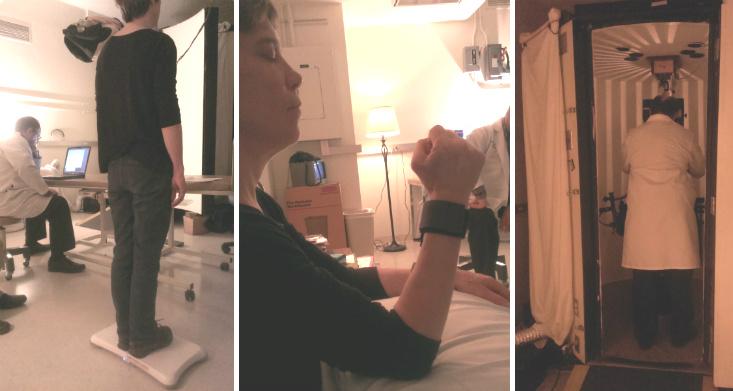
The idea behind Dai'south treatment is to create a visual experience that re-trains the vestibulo-ocular reflex. Equally Perry took in a striped world moving constantly to the right, her reflex compensated by moving her eyes to the left. This equal and contrary reaction, Dai posited, would cancel out the unnecessary bounty that Perry'south encephalon had been constantly performing—the clockwise circular swaying she has perceived for 4 months straight.
When Perry emerged from the bedroom, she stood with her eyes closed for a few moments and focused on her sensations. "I feel the circular motion less," she reported. But she yet felt the flooring bobbing below her. So Dai timed the frequency of the bobbing, then sent her back into the bedchamber to picket horizontal stripes move downwardly the walls.
That first session was just the get-go; Perry went to Mountain Sinai all calendar week for treatments. A couple days subsequently, her sensation of bodily movement was almost completely gone, and the Wii Balance Board confirmed that she was no longer swaying in circles. "That was the part that was really agitating," she said, "I exercise feel better, for certain." However, Dai's treatment didn't succeed in taking away her perception of the ground surging beneath her feet. The md told her to accept heart, Perry says, and said that sensation likewise will likely fade away in the coming months, particularly if she stays off the Klonopin medication that was suppressing the activity of her vestibular organisation and preventing it from readjusting. Perry said that after iv destabilizing months, she finally felt hopeful. "I'm halfway off the boat," she said.
Eliza Strickland is an associate editor for the scientific discipline and technology magazine IEEE Spectrum .
WATCH: Why our feelings are more like perceptions than sensations.

This classic Facts So Romantic mail was originally published in December 2014.

Get the Nautilus newsletter
The newest and most popular articles delivered right to your inbox!
Source: https://nautil.us/what-to-do-when-your-brain-insists-youre-always-on-a-boat-2-7027/
0 Response to "Mal De Debarquement Syndrome (Mdds) Treatment at Mount Sinai Reviews"
Post a Comment